

Start Slow/Finish Fast
Negative Split Strategy
Negative split refers to a running strategy where the second half of a run or race is completed faster than the first half. The idea is to conserve energy early on, allowing for a stronger, more efficient finish. Far too often, inexperienced runners (and even experienced ones) let too many horses out the gates early. There are many reasons why this happens; you may be anxious to race or you may be gunning for that sweet sweet PR. Whatever the reason, out pacing your race early will lead to fatigue and disappointment when you just don’t have the gas left to make that finishing push.
Benefits of Negative Splits
- Energy Conservation: By starting at a more controlled pace, you prevent early fatigue and ensure you have enough energy for a strong finish.
- Improved Performance: Negative splits are linked with faster overall race times because they reduce the likelihood of “hitting the wall” or slowing down significantly in the later stages.
- Psychological Benefit: Passing other runners in the latter part of a race can boost confidence and motivation, helping maintain or increase speed.
- Training Efficiency: It trains your body to maintain and even increase intensity when fatigued, improving endurance and mental toughness.
Incorporating Negative Splits into Races:
- Start Conservatively: Begin the race at a pace slightly slower than your goal pace. This requires discipline, especially when adrenaline and excitement might tempt you to start fast.
- Gradual Speed Increase: Plan to increase your speed progressively, particularly in the latter half or final third of the race. The increase should feel controlled, not forced.
- Monitor Your Pace: Use a GPS watch or mile markers to keep track of your pace. Make sure the pace increase is steady, avoiding a sudden burst of speed that could lead to burnout.
- Final Push: As you near the finish, use any remaining energy for a strong sprint, capitalizing on the energy conserved earlier in the race.
How to train using Negative Splits
You can utilize negative splits in your training plan for pretty much any type of training, but it is easiest to work it into your long runs.
Example: For a 10-mile run, run the first 5 miles at an easy pace (e.g., 9:30/mile), then gradually increase your pace so that the last 5 miles are closer to 8:45/mile. Note that the times in this example are just that. Use your race pace when adding negative splits to your training.
Calculating Negative Splits
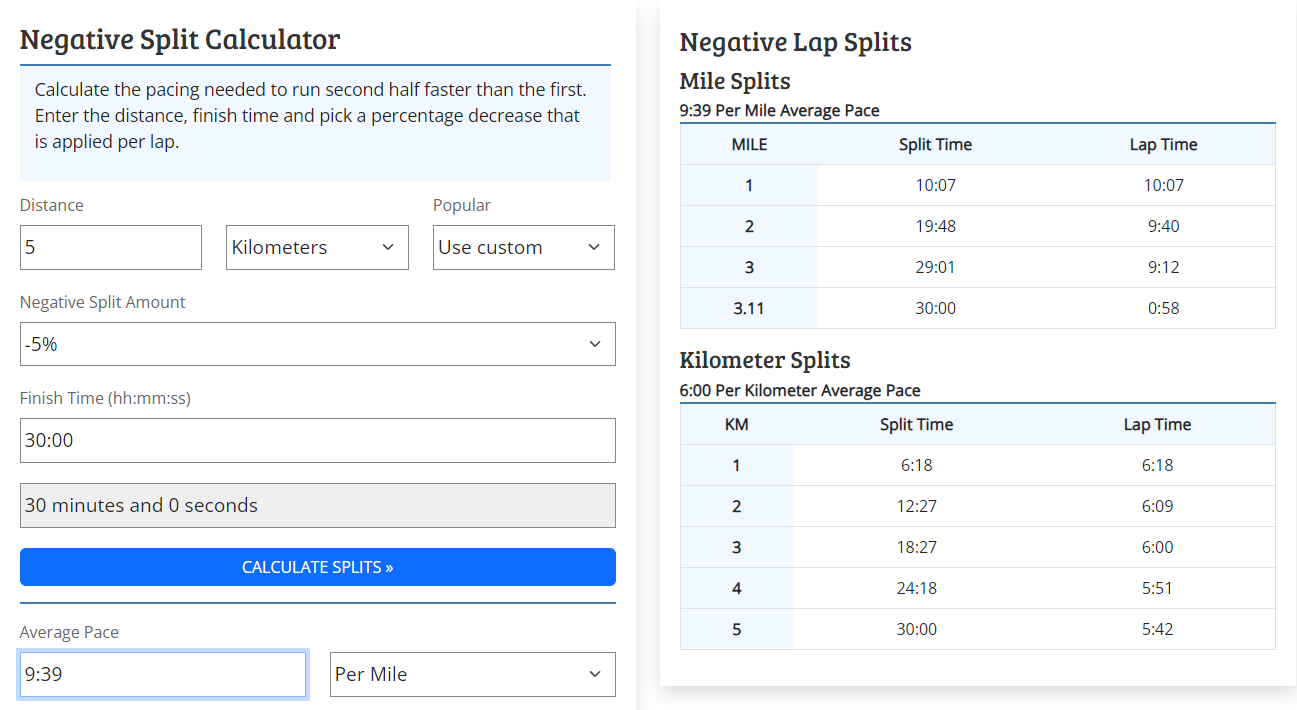
There are online calculators, like the one this screenshot, that will tell you how to pace for negative splits. In this case, I have entered a 5k with a split decrease of 5% and a finish time of 30 minutes. This tells me I need to avg a pace of 9:39min/mile and gives me a breakdown of how fast to run each mile (or km if you prefer).
Tips for Success:
- Pacing Practice: Incorporate pacing runs in your training to develop a good sense of what different paces feel like.
- Stay Patient: It can be tempting to speed up too early, so practice restraint, especially in races.
- Use It Wisely: Negative splits work best in longer races (10K and above), where energy management is crucial.