

Running Primer – Part 6
You Better Work!
In order to know if your running future is Sashay Away or Shantay You Stay… you’ll need to track running effort. Tracking running effort metrics like Heart Rate (HR) Zones, Threshold Pace Zones, and perceived exertion is crucial in training for several reasons:
1. Personalization and Efficiency
- Heart Rate (HR) Zones: HR zones allow you to train at the intensity that is best suited to your current fitness level. By staying within specific HR zones, you can ensure you’re working at the right intensity for your goals, whether that’s building endurance, increasing speed, or improving recovery. This prevents undertraining or overtraining.
- Threshold Pace Zones: Knowing your threshold pace (the pace at which lactate begins to accumulate in your blood) helps you train more effectively by targeting workouts that improve your ability to sustain higher intensities. Training within these zones helps improve your lactate threshold, which is key for long-distance running.
2. Avoiding Overtraining and Injury
- Heart Rate Monitoring: Tracking HR can help you avoid overtraining. If your heart rate is unusually high for a given effort, it may indicate fatigue or the onset of illness. Adjusting your workout based on this data can prevent injury or burnout.
- Perceived Exertion: Understanding perceived exertion allows you to adjust your training intensity based on how your body feels, especially when external factors (like heat, fatigue, or stress) affect your performance. This subjective measure complements objective data and helps you train smarter.
3. Improved Performance
- HR and Threshold Zones: By consistently training in the appropriate HR and threshold pace zones, you can optimize your workouts to build endurance, speed, and stamina more efficiently. This structured approach leads to faster improvements in performance compared to unstructured training.
- Perceived Exertion: Experienced runners can fine-tune their pacing strategies for races by relying on perceived exertion. This helps them maintain the right intensity throughout a race without burning out too early.
4. Recovery and Adaptation
- Heart Rate Monitoring: Monitoring your resting heart rate and HR variability can indicate how well you’re recovering. A higher than normal resting heart rate might suggest that you need more recovery time before your next hard workout.
- Perceived Exertion: Regularly assessing perceived exertion helps you listen to your body, which is essential for allowing adequate recovery. Understanding when to push hard and when to back off leads to better adaptation and long-term improvements.
5. Data-Driven Insights
- HR and Pace Data: Over time, tracking these metrics provides valuable insights into your progress, helping you understand how your fitness is improving and where you might need to adjust your training.
- Perceived Exertion: Combining perceived exertion with objective data (like HR and pace) helps you correlate how you feel with actual performance, making you a more intuitive and adaptive runner.
6. Race-Day Strategy
- HR and Pace Zones: On race day, understanding your HR and threshold pace zones allows you to pace yourself more effectively, ensuring that you start at a sustainable speed and finish strong.
- Perceived Exertion: When conditions are unpredictable, relying on perceived exertion helps you adjust your race strategy in real-time, optimizing performance even when things don’t go as planned.
In summary, tracking running effort metrics is essential for personalized, effective training, injury prevention, performance enhancement, and informed race-day strategies. These metrics help you train smarter, not just harder, leading to better results and a more sustainable running journey.
Training Zones
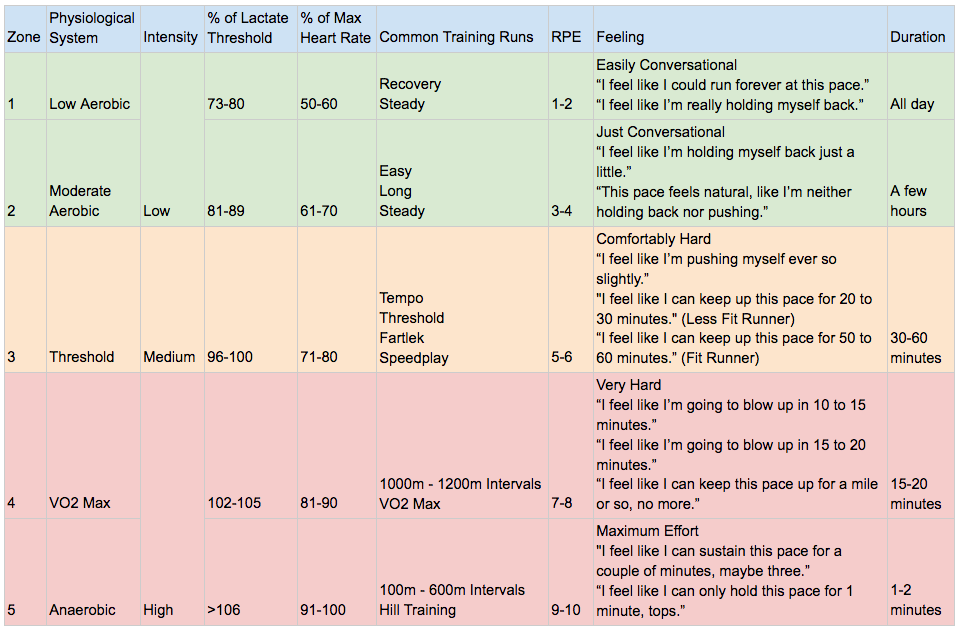
The following chart shows zone information corresponding to Pace (column: % of Lactate Threshold), Heart Rate (column: % of Max Heart Rate) and Rate of Perceived Exertion (columns: RPE and Feeling)
Lactate Threshold
To determine your Lactate Threshold (LT) please see Part 5 of this series. Once you have determined your LT, you can easily calculate each zone using the % of Lactate Threshold column.
Maximum Heart Rate
You can estimate your maximum heart rate by using the formula MHR = 220 – Your Age. For a more precise maximum heart rate, you can do a field test by following these steps:
- Warm up for 10-15 minutes.
- Run at a steady, hard pace for 3 minutes.
- Recover for 2 minutes with easy jogging or walking.
- Run again for 3 minutes at your maximum effort.
- The highest heart rate you reach during this final 3-minute run is a good estimate of your MHR.
Note: A field test should only be done if you are in good health and with approval from your doctor.
As with Pace Zones, you can use the % of Maximum Heart Rate column to calculate each HR zone.
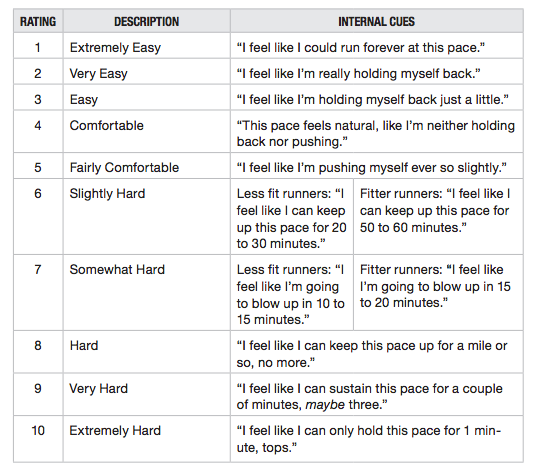
Rate of Perceived Exertion
This is a feelings based metric and is most personal to you. Do not discount this metric as it can be useful, especially when used alongside the Pace and HR Zones to determine not only the effort you are putting in, but keeps you in tune with what your body is telling you.
Medical Considerations
For people who have medical conditions or take medication that affect heart rate, using HR zones can be a challenge. If you are in this category, it is even more important to utilize RPE to determine how hard you are exerting yourself. People in this category will also see a disconnect between HR Zones and Pace Zones. You will likely need more time spent doing running workouts to better gauge your maximum heart rate.
Electronic Tracking
If you use a sports watch or have other wearables that track HR and Pace, you may be able to use the apps or websites for those devices to manually adjust your zones if needed. You can also use these apps/websites that log activities to track your progress over time.
Keeping Notes
Your tracking app/website should offer the ability to enter RPE (typically in the form of Easy, Moderate, Hard type of categories) and also allow you to capture additional notes about activities. If you don’t use an electronic device then use good old paper/pen (or if you are like my buddy Jim you may be more comfortable with using a stone tablet and chisel) to record how you are feeling and any circumstances (eg injuries, weather, elevation) that affect your effort level.
Training Plan References
You will find most training plans will indicate workouts by either HR Zones, Pace Zones or RPE. You will see words like comfortable or conversational, recovery, aerobic and threshold to denote how hard you should be running. You may find it difficult at first to stay within those zones, but in time that will become easier.
There is one trick I used to help me maintain pace. If you run with an electronic device and have earphone, you can use one of the following options for tempo:
- Music with a specific beat tempo (you can find play lists at various tempos)
- Drum music with specific beat tempos
- A digital metronome
When I started walking, I used music to keep up a pace. As I transitioned into running, I needed a faster and more stable beat so I used drum beats at various beats per minute (bpm). I used my watch while running to get into a particular zone and then found the right bpm drum beat to keep me in that zone. Yes, listening to the same <thump><thump><thump> for 45 minutes can be a bit much, but I needed the help otherwise my pace would be all over the place.
Another trick, if your watch has activity alerts, you can typically set an alert if you go outside of a range. This doesn’t prevent you from drifting any more than Botts dots or rumble strips on the highway will prevent you from drifting, but it will alert you when you drift too far.
Do these zones change?
Your heart rate zones are going to stay pretty static. As you build endurance, you’ll have to work harder to get into those zones but for the most part your max heart rate will not change and the percentage calculations will be the same.
Pace zones will change as you build endurance and gain speed. Today you could be in zone 2 at 12 min/mile but in 3 months zone 2 could be 10 min/mi.
Perceived effort will also change as you build endurance. A level 4 RPE today could be a level 2 in the future.
Next Part in this Series
Coming up next will be a sample training plan, unless I discover some other piece of information that needs to be addressed before I put out that plan. So be on the look out for notification of Part 7 and as always, please comment if you are finding this information valuable or have questions.